
Lesson 9: The Battles of Trenton and Princeton
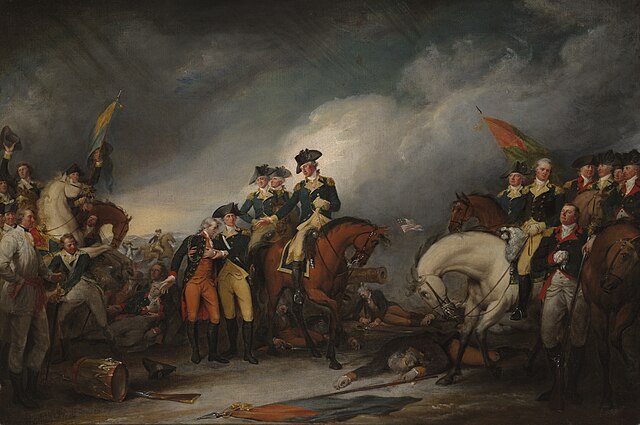 |
| Capture of the Hessians at Trenton |
The Battles of Trenton and Princeton
This is a summary of one of my favorite battles. The setting is New Jersey. George Washington has his men for a few days more and then their enlistment is up. He really wants to do something, but what? He decides to attack Trenton. One eye witness said, “I rode along the river yesterday morning and could see the Hessians in Trenton. It is a pretty village, containing about 130 houses and a Presbyterian meeting-house. A stone bridge spans the Assunpink creek on the road leading to Bordentown. There are apple orchards and gardens.”
Newtown, Pennsylvania is where George Washington has his headquarters. He has just been chased out of New York, but luckily all the boats are on his side of the river. George Washington had stationed a spy named John Honeyman, posing as a Tory, in Trenton. Honeyman was a butcher and bartender, who traded with the British and Hessians. This enabled him to gather intelligence and to convince the Hessians that the Continental Army was in such a low state of morale that they would not attack Trenton. Shortly before Christmas, he arranged to be captured by the Continental Army, who had orders to bring him to Washington unharmed. After being questioned by Washington, he was imprisoned in a hut to be tried as a Tory in the morning, but a small fire broke out nearby, enabling him to “escape".
Washington's plan relied on launching coordinated attacks from three directions. General John Cadwalader would launch a diversionary attack against the British garrison at Bordentown, New Jersey. General James Ewing would take 700 militia across the river at Trenton Ferry, seize the bridge over the Assunpink Creek and prevent enemy troops from escaping. The main assault force of 2,400 men would cross the river 9 mi (14 km) north of Trenton and split into two groups, one under Greene and one under Sullivan, to launch a pre-dawn attack.
The weather on the night before the attack was so bad that visibility was reduced to almost zero. It was impossible for generals Cadwalader and Ewing to join the attack. Washington also realized it would be impossible to launch a pre-dawn attack. At one point, General Sullivan sent a courier to tell Washington that the weather was wetting his men's gunpowder. Washington replied, "Tell General Sullivan to use the bayonet. I am resolved to take Trenton.
On the night of December 25, the American main force was ferried across the Delaware River by Colonel John Glover's Marblehead fishermen beginning at 11 pm. They were hit with a harsh rain. By midnight it had turned to a mix of sleet and snow. The attack was a surprise because British spies kept giving the Hessian commander false alarms and the weather being horrible, no one thought anything would happen on Christmas!
Once all the men had crossed the river, they began to march towards Trenton. It was about 4:00 am. Many of the troops did not have boots, so they were forced to wear rags around their feet. Some of the men's feet bled, turning the snow to a dark red. Two men died on the march.
At 8 am Washington led the assault from the northwest, riding in front of his soldiers. General Sullivan entered Trenton from the South and blocked the only crossing over the Assunpink Creek to cut off the Hessian escape. With the sounding of the alarm, the three Hessian regiments began to prepare for battle. The Colonial troops began firing with their cannon breaking Hessian resolve. Colonel Rall ordered a 3-pound cannon into action but it was quickly overtaken by the colonists. The Hessian troops had trouble getting their guns to fire in the bad weather. Colonel Rall was mortally injured (shown in this painting by John Trumbull).
Washington soon learned however that Cadwalader and Ewing had been unable to complete their crossing, leaving his worn-out army of 2,400 men isolated. Without their 2,600 men, Washington realized he did not have the forces to attack Princeton and New Brunswick. By noon, Washington's force had moved across the Delaware back into Pennsylvania, taking their prisoners and captured supplies with them.
Following the victory at the Battle of Trenton early in the morning of December 26, 1776, General George Washington of the Continental Army and his council of war expected a strong British counterattack. Washington and the council decided to meet this attack in Trenton and established a defensive position south of the Assunpink Creek. Lieutenant General Charles Cornwallis led the British forces with about 5,000 men on January 2. His advance was significantly slowed by defensive skirmishing by American riflemen under the command of Edward Hand, and the advance guard did not reach Trenton until twilight.
Washington ordered Brigadier General Roche de Formoy to form an outer defensive line halfway between Trenton and Princeton. As the British approached, De Formoy came back to Trenton drunk so Colonel Edward Hand took command. Each time the British would line up in a battle line, the riflemen under Hand would fall back and fire from cover. The roads were slushy with melted snow and some parts were knee deep in mud. By three in the afternoon, the British had reached a ravine known as Stockton Hollow, about a half a mile (0.8 km) from Trenton where the Americans were forming another line of defense. As Hand's troops came to the swollen Assunpink creek, the Hessians charged at them with bayonets fixed, causing chaos among the Americans. Washington, seeing the chaos, rode out through the crowd of men crossing the bridge and shouted that Hand's rear guard pull back and regroup under the cover of the American artillery. The British charged the bridge again but were driven back by cannon fire. The British charged one final time, but the Americans fired canister shot this time, and the British lines were raked with fire. One soldier said, "The bridge looked red as blood, with their killed and wounded and their red coats.”
Cornwallis and his men debated whether to attack Washington in the dark or wait until morning to finish the battle. Quartermaster general Erskine said "If Washington is the General I take him to be, his army will not be found there in the morning.” Grant argued that there was no way for the Americans to retreat, and that the British troops were worn out, and that it would be better for them to attack in the morning after they had rested. Rather than stay and fight Cornwallis, Washington decided to leave and attack Princeton. By 2 am on January 3, the army was on its way to Princeton. Washington left behind 500 men and two cannon to keep the fires burning and to make noise with picks and shovels to make the British think they were digging in. By morning, these men too had evacuated, and when the British came to attack, all of the American troops were gone. During the night the temperatures dropped. The roads that had been muddy and difficult for the British froze solid, and General Washingtons troops made excellent time in getting to Princeton. The men were ordered to march with silence. Along the way, a rumor was spread that they were surrounded, and some frightened militiamen fled for Philadelphia.
Cornwallis had left Lieutenant Colonel Mawhood to guard Princeton. In order to have reinforcements for the Battle at Assunpink Creek, Cornwallis had sent orders to Mawhood to bring the 17th and 55th British regiments to join his army in the morning. Mawhood had moved out from Princeton to fulfill these orders when his troops climbed the hill south of Stony Brook and sighted the main American army. Unable to figure out the size of the American army because of the wooded hills, he sent a rider to warn the 40th British Regiment, which he had left in Princeton, then wheeled the 17th and 55th Regiments around and headed back to Princeton. Mawhood’s men engaged with Hugh Mercer’s men and killed Mercer thinking they had caught George Washington. Fifty light infantrymen were in pursuit of Mercer's men when a fresh brigade of 1,100 militiamen under the command of Cadwalader appeared. Cadwalader’s men had no combat experience and did not know even the most basic military maneuvers. When his men reached the top of the hill and saw Mercer's men fleeing from the British, most of the militia turned around and ran back down the hill. As Cadwalader's men began to flee, the American guns opened fire onto the British, who were preparing to attack, and the guns were able to hold them off for several minutes. Washington ordered the riflemen and the Virginians to take up a position on the right hand side of the hill, and then Washington quickly rode over to Cadwalader's fleeing men. Washington shouted, "Parade with us my brave fellows! There is but a handful of the enemy and we shall have them directly!". Cadwalader's men formed into battle formation at Washington's direction.
Washington, with his hat in his hand, rode forward and waved the Americans forward, while he rode ahead on his horse. At this point, Mawhood had moved his troops slightly to the left to get out of the range of the American artillery fire. Washington gave orders not to fire until he gave them the signal, and when they were thirty yards away, he turned around on his horse, facing his men and said "Halt!" and then "Fire!". At this moment, the British also fired, obscuring the field in a cloud of smoke. One of Washington's officers, John Fitzgerald, pulled his hat over his eyes to avoid seeing Washington killed, but when the smoke cleared, Washington appeared, unharmed, waving his men forward.
After entering Princeton, the Americans began to loot the abandoned British supply wagons and the town. With news that Cornwallis was approaching, Washington knew he had to leave Princeton. Washington wanted to push on to New Brunswick and capture a British pay chest of 70,000 pounds, but Major Generals Henry Knox and Nathanael Greene talked him out of it. Instead, Washington moved his army to Somerset Courthouse on the night of January 3, then arrived at Morristown by sunset the next day for winter encampment. After the battle, Cornwallis abandoned many of his posts in New Jersey and ordered his army to retreat to New Brunswick. All winter, Washington’s men engaged Cornwallis’ men in small skirmishes every time they came out to get forage for their horses.
This battle was a turning point in the war. The weather that favored Washington and not the British showed the divine hand of Providence. It was George Washington's first victory at a time when his men were about to go home as their enlistment term was up.
Books
Crossing the Delaware 564 pages
Free Books
Washington Crossing the Delaware by Fisk
Washington Crossing the Delaware by Leutze
Videos
The Crossing is an unrated film that is very good however, it shows an ambush of a guard shack with some close up footage of the death of some British soldiers which would probably warrant an R rating. There is also a lot of profanity.
The Capture of General Lee
General Lee was Washington's best trained general. However, as Washington had successive losses, he wanted to take command. Lee was slow to follow an order to bring his troops to New Jersey because he wanted to stay in New York. He was captured at Widow White's Tavern in New Jersey by the British. It was actually a blessing that George Washington got rid of Lee because he was more trouble than he was worth. Richard Stockton, a signer of the Declaration of Independence, was also captured in New Jersey by the British as he was trying to evacuate his family. He lost everything and was imprisoned by the British with little food and freezing temperatures but he would not renounce the cause.
Image Credit: John Trumbull / Yale University Art Gallery / Public Domain