
Week 22: More Ancient Greece
Ancient History Resources for Homeschool and Personal Study. This weeks topics: Greek Drama, Archimedes and Aristotle, Burial rituals, Alexander the Great
Ancient History is studied through the collection of archeological evidence, written records and oral stories or myths. Just because evidence shows a particular belief or custom was common at a particular time does not mean that everyone in that civilization shared that belief. When you study the topics for this week, you can either go deep on one topic for the week and skip the others or you can do a new topic each day. This outline is just a suggested pace, you can go slower or faster as needed. This outline is intended to provide you with a place to start. You will still need to do your own research.
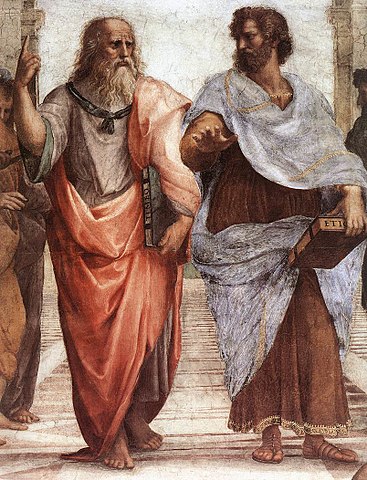 |
| School of Athens (cropped from the original) |
Homeschool Topics for Week 22
Greek Drama
Archimedes and Aristotle
Burial Rituals
Alexander the Great
Discussion Questions
Greek Drama
The drama that developed in the fifth century Greece consisted of tragedies and comedies. The tragedies were based on epic stories with human characters. The comedies dealt with issues of the times and often the gods and heroes made cameo appearances. The first actor was named Thespis. He did plays from the back of his cart. His performances were a dialogue between himself and his chorus kind of like an oratorio. The original theater was open air. The performing area was called the "orchestra."
Archimedes and Aristotle
Archimedes is the mathematician who discovered many useful principles. His ideas were put to use in defending the city of Syracuse from Roman invaders. Most of his writings were lost when the library at Alexandria was destroyed
Aristotle was taught by Plato and he in turn tutored Alexander the Great. His early scientific training came from his father who was the King's physician. He made observations of the natural world but did not do scientific experiments. He was a philosopher and trained in rhetoric.
Greek Burial Rituals
The Greeks believed that every person had a soul. However, they did not agree on what happened to the soul after death. Some thought the soul lived in a tomb and needed feeding. Others thought the soul went to the Underworld. They had to be remembered or they would fade away. Most dead bodies were cremated. View a 3D model of a Greek sarcophagus with a story of eternal youth carved into it here.
Alexander the Great
Books (all links go to Goodreads)
BBC Ancient Greek Influence on Drama and Entertainment Part 1
The Battle of the Greek Tragedies TED-Ed (What makes Oedipus a tragedy is that he kills his father and marries his mother by mistake and then takes out his eyes when he figures it out. Mature themes depicted lightly)
What really happened to the Library of Alexandria?
The Tragic Myth of Orpheus and Eurydice
A Day in the Life of an Ancient Greek Oracle
A Day in the Life of an Ancient Greek ArchitectActivities
1. Write an imaginative ending to the library of Alexandria. Were any of the books saved? Where are they hidden?
2. Is death the greatest ending of a tragedy or is there a better (sadder) ending?
Image Credit: Public Domain / Wikimedia Commons / Public Domain